
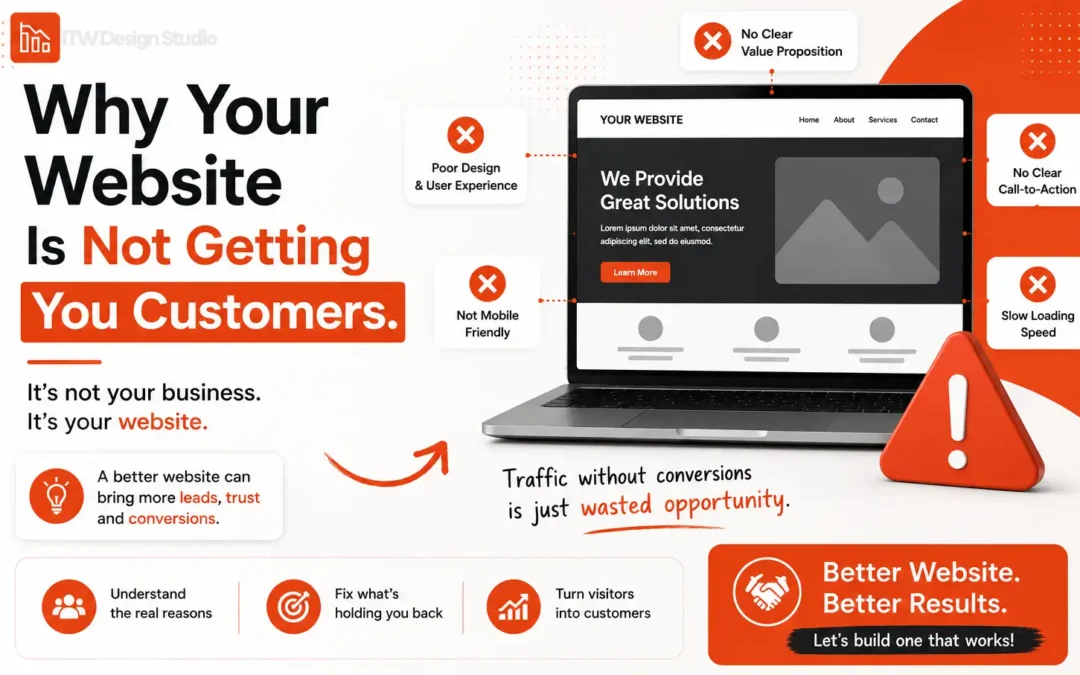
Why Your Website Is Not Getting You Customers
You have a website. You may even be getting some visitors. But the phone is not ringing. Enquiries are not coming in. And you are starting to wonder whether a website is actually worth it.
Here is the honest truth: in most cases, the problem is not that you have a website. The problem is what your website is doing, or more accurately, what it is failing to do.
Below are the seven most common reasons small business websites do not convert, and what you can do about each one.
1. Your Website Does Not Pass the Three-Second Test
When someone lands on your website for the first time, they make a judgment in about three seconds. Not a considered one. An instinctive one.
In those three seconds, they are asking: Does this look credible? Is this for me? Do I trust this business?
If your homepage does not answer those three questions immediately, most visitors leave without reading a single word. It does not matter how good your services are or how competitive your pricing is. They are already gone.
The fix: Your homepage headline needs to communicate clearly what you do, who you do it for, and why you are different. Not your company history. Not a generic welcome message. A direct, specific statement that tells the right visitor they are in the right place.
2. You Are Talking About Yourself Instead of Your Customer
This is the most common mistake on small business websites. The homepage talks about the company’s history, values, and achievements. Every section is written from the inside out.
Customers do not visit your website to learn about you. They visit because they have a problem and they want to know if you can solve it.
The fix: Rewrite your copy from the customer’s perspective. Lead with their problem, not your credentials. Use “you” and “your” more than “we” and “our.” The best websites make the visitor feel understood before they make the visitor feel impressed.
3. There Is No Clear Next Step
A visitor reads your services page. They are interested. Then they do not know what to do next. There is no prominent call to action, or there is one buried at the bottom that just says “Contact Us.” That is not enough.
The fix: Every page on your website should have one clear next step. Not three. One. Make it specific, such as “Book a free 30-minute call” rather than “Get in touch.” Make it visible. Reduce the friction involved in taking that step as much as possible.
4. Your Website Is Slow on Mobile
More than 60% of web traffic now comes from mobile devices. If your website takes more than three seconds to load on a phone, a significant portion of your visitors will leave before the page even finishes loading.
Google’s data shows that for every additional second of load time, conversion rates drop significantly. A slow website is not just an inconvenience. It is actively costing you customers.
The fix: Run your website through Google PageSpeed Insights and focus on the mobile score. Key issues to address are image file sizes, unnecessary plugins, unoptimised code, and hosting quality. A well-optimised website should score above 80 on mobile.
5. Your Content Does Not Build Trust
When someone finds your website through a Google search, they have never met you. They do not know you. And they are being asked to hand over their money or at minimum their personal details.
Trust is built through specifics, not generics. “High quality service” means nothing. “We have delivered projects for over 700 clients across 15 countries since 2003” means something.
The fix: Add proof to your website. Real results, specific numbers, case studies with context, client testimonials with names and industries. The more specific the proof, the more trust it builds.
6. You Are Attracting the Wrong Traffic
Sometimes the website itself is fine, but the visitors it is attracting are not the right ones. You might be ranking for keywords that bring browsers rather than buyers, or getting traffic from people who are not your target market.
Traffic without intent does not convert. A thousand visitors who are not looking for what you sell is less valuable than a hundred who are.
The fix: Look at what search terms are bringing people to your site. Are they specific and commercial, like “web design agency for restaurants in Bangalore,” or broad and informational, like “what is web design”? If your site is attracting the wrong intent, your SEO strategy needs to be refined.
7. Your Website Looks Like It Was Built in 2014
Design trends evolve. More importantly, customer expectations evolve. A website that looked professional five years ago can look dated today, and that signals to potential customers that your business may not be current or invested.
The fix: If your website is more than four years old, it is worth getting a design audit. Sometimes a relatively small refresh can make a significant difference. Sometimes a full redesign is the right call. Either way, the investment typically pays for itself quickly in improved conversions.
The Common Thread
Every one of these problems comes down to the same thing: the website is not designed around the customer’s journey. It exists as a digital brochure rather than a conversion tool.
A good small business website does three things: it earns trust quickly, it helps the right visitor understand you are the right choice, and it makes taking the next step easy. When all three work together, enquiries follow.
Where Does Your Website Stand?
If you are not sure which of these issues applies to your site, we offer a free 30-minute strategy call where we will look at your website honestly and tell you what is holding it back. No report to buy. No sales pitch. Just a straight conversation about what your website needs to do differently.
Recent Comments